Tea at Eleven
Pierwszy dzień w pracy zaczyna się od zasad. Zwróć uwagę na dwa rodzaje zdań: takie, które mówią, co dzieje się teraz (Dickens is sleeping), i takie, które mówią, co dzieje się zawsze (Hamish reads the paper every day). Wyjaśnienie znajdziesz pod czytanką.
Tea at Eleven
Czytanka 1 · 24 zdaniaIt’s Tuesday morning. Zosia is in the shop at half past eight. The shop opens at ten. Morag arrives at five to ten, with a newspaper and a big bag. ‘You’re early,’ she says. It isn’t a compliment. Zosia has got a new notebook and three pens. ‘Can you tell me the rules of the shop, please?’ Morag looks at the notebook. Then she looks at the three pens. ‘Rule number one. Tea is at eleven and at three.’ ‘Not at ten past eleven. Not at five to three.’ Zosia writes it down and underlines it twice.
‘Rule number two. Never say the word Kindle in this shop.’ ‘Why not?’ asks Zosia. ‘Those are for people who don’t like paper.’ ‘Rule number three. The red armchair is Dickens’s chair.’ Right now, Dickens is sleeping on the till, not in the armchair. ‘He never sits in it. But nobody else can.’
At five past ten, the bell rings. An old man in a flat cap comes in. He takes a newspaper from the pile and sits by the window. ‘That’s Hamish,’ says Morag. ‘He reads the paper here for free.’ ‘Every day. Since the nineteen-eighties.’ ‘Aye. And I’m still waiting for my cup of tea,’ says Hamish. ‘It’s ten past ten, Hamish. Tea is at eleven.’ Hamish winks at Zosia. ‘She says that every day.’
The Rules of the Shop
Tekst użytkowy prosto zza lady: kartka przypięta pinezką obok kasy, pismo Morag. Ostatni punkt dopisał ktoś inny — zgadniesz kto. Zwróć uwagę, jak krótkie są zdania w regulaminach: bez „proszę”, bez „uprzejmie informujemy”.
The Rules of the Shop
Tekst użytkowy · kartka przy kasie
The Rules of the Shop
1. Tea is at 11 am and at 3 pm. No exceptions.
2. Never say the word ‘Kindle’.
3. The red armchair belongs to Dickens.
4. Do not feed the cat. He is not hungry. He is lying.
5. Hamish can read the newspaper. He can’t do the crossword.
6. The customer is not always right. But customers are always welcome.
7. Hamish is always right. H.K.
🗂️ Ważne słowa z czytanki 1 i z regulaminu
Kliknij kafelek — usłyszysz słowo. Przy czasownikach nieregularnych w nawiasie podajemy formy przeszłe — przydadzą się od rozdziału 5.
🧩 Jak to działa: Present Continuous czy Present Simple?
Po polsku „Dickens śpi” znaczy i „śpi właśnie teraz”, i „sypia (zwykle)”. Angielski to rozróżnia. Present Continuous (am / is / are + czasownik z -ing) mówi o tym, co dzieje się teraz, na naszych oczach. Present Simple — o tym, co dzieje się zawsze, codziennie, zwykle.
| Teraz — Present Continuous | Zawsze, zwykle — Present Simple |
|---|---|
| Dickens is sleeping on the till. | Dickens never sits in the armchair. |
| Two tourists are looking for a café. | Hamish reads the paper every day. |
| I’m still waiting for my tea! | She says that every day. |
| now, right now, at the moment, today | always, never, every day, usually, at eleven |
Hamish reads the paper here every day.
Morag is doing the crossword.
Uwaga: czasowniki „stanu” — like, know, want, remember, believe — prawie nigdy nie dostają -ing, nawet gdy chodzi o „teraz”: She likes green (nie: is liking), I can’t remember the title.
W księgarni The Second Chapter
👆 Kliknij dowolny przedmiot na obrazku — usłyszysz jego angielską nazwę.
Customers
Druga czytanka to galeria klientów. Śledź ceny i liczby — w Wielkiej Brytanii mówi się je trochę inaczej niż w szkole: three pounds fifty, a nie „three point five pounds”.
Customers
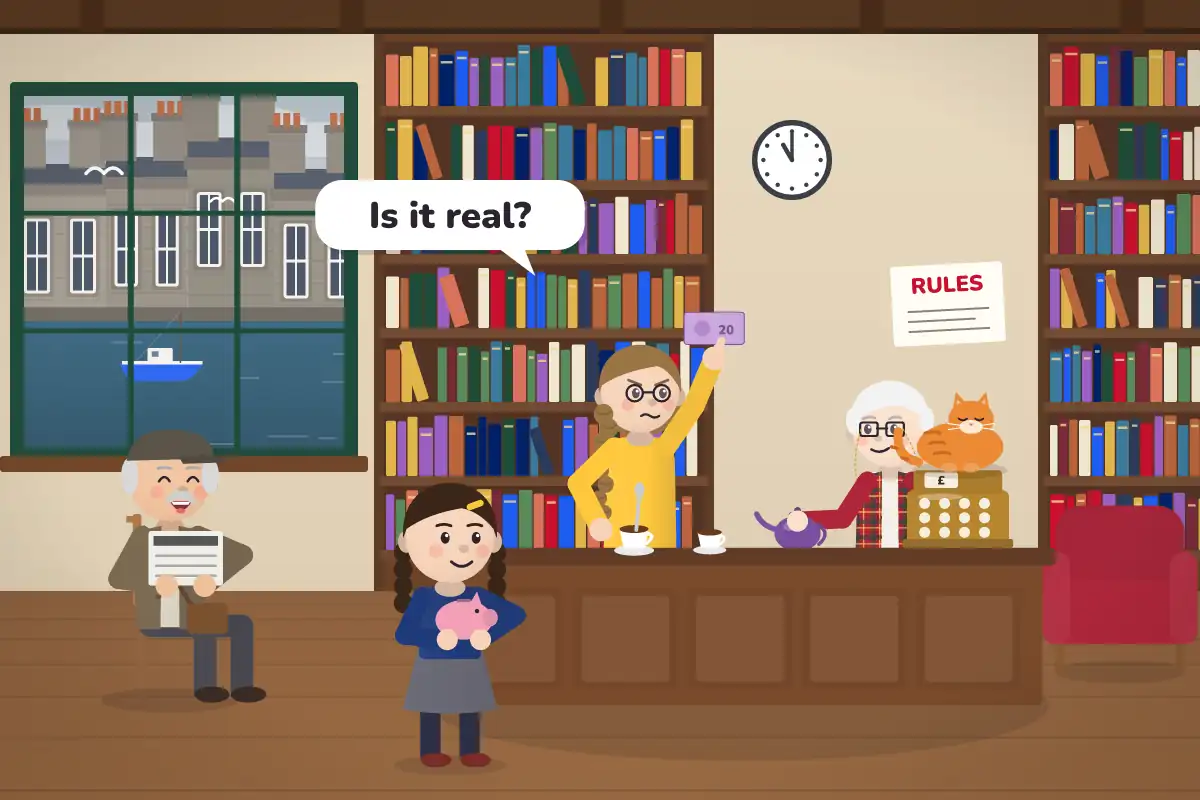
Czytanka 2 · 29 zdańAt eleven o’clock exactly, Morag makes tea. It’s very strong and very brown. ‘Strong enough to stand a spoon in,’ says Hamish happily. Then the customers start to come in. Two young tourists are looking for a café. ‘Where’s the café where Harry Potter was born?’ asks the girl. ‘Every café in Edinburgh says that,’ says Morag. ‘Try the Old Town.’
Then a tall old gentleman comes in. ‘I’m looking for a book,’ he says. ‘It’s blue. I can’t remember the title.’ ‘Can you remember the author?’ asks Zosia. ‘No. But it’s blue. Quite a big book.’ Zosia finds five big blue books. The gentleman looks at them carefully, one by one. Then he buys a green one. ‘For my wife. She likes green.’
At three, a little girl comes in with a piggy bank. Her name is Katie. She’s seven, and she lives in Leith. She wants a book about dogs. It costs three pounds fifty. Katie counts her coins on the counter. ‘One pound, two pounds, three pounds… and forty-seven pence.’ She’s three pence short. Katie looks very sad. Morag looks at the coins. Then she looks at the price. ‘Three pounds forty-seven,’ she says. ‘That’s the price today.’ Zosia can’t believe it. Morag can be nice! ‘Don’t tell anybody,’ says Morag, and goes back to her crossword.
At five, a man pays with a twenty-pound note. The note is from a Scottish bank. It looks very strange. Zosia holds it up to the light. Is it real or fake? Hamish laughs. ‘It’s real, dear. That’s Scottish money.’ ‘Some shops in England don’t like it. We love it.’
💷 Ciekawostka: szkockie banknoty, pensy i różnice UK / US
W Szkocji banknoty drukują trzy banki: Bank of Scotland, Royal Bank of Scotland i Clydesdale Bank. Każdy ma własne wzory, więc w portfelu Szkota może być kilka różnych dwudziestek — stąd panika Zosi. To jednak zupełnie prawdziwe funty szterlingi; w Szkocji płaci się nimi tak samo jak banknotami Bank of England. W Anglii niektóre sklepy przyjmują je niechętnie. Hamish uważa to za osobistą zniewagę.
1 funt = 100 pensów. Ceny czyta się bez „i” i bez „przecinka”: £3.50 to three pounds fifty, 47p to forty-seven pence albo po prostu forty-seven p [piː]. Potocznie funt to a quid — i nie ma liczby mnogiej: five quid.
| Po polsku | W Wielkiej Brytanii | W USA |
|---|---|---|
| sklep | a shop | a store |
| banknot | a note | a bill |
| herbatnik, ciastko | a biscuit | a cookie |
| kasa w sklepie | a till | a cash register |
| kolejka | a queue | a line |
| cukierki, słodycze | sweets | candy |
A biscuits do herbaty o jedenastej to w The Second Chapter osobna zasada — ale tej Morag nie zapisała. Tę się po prostu wie.
Can I Speak to the Boss?
💬 Can I speak to the boss, please?
Późne popołudnie. Elegancki pan w płaszczu chce porozmawiać z szefową. Zosia słyszy boss, w głowie tłumaczy „szef”… i z ust wychodzi jej coś zupełnie innego.
🙈 Wpadka Zosi: chef to NIE „szef”!
Klient pyta o the boss. Zosia w ułamku sekundy tłumaczy w głowie: boss → „szef” → chef. Brzmi prawie tak samo, tylko że chef [ʃef] to szef kuchni, kucharz w restauracji. Nic dziwnego, że pan zaczyna szukać kawiarni.
| Po polsku | Po angielsku | Przykład |
|---|---|---|
| szef, szefowa (w pracy) | a boss, a manager | My boss is Morag. |
| szef kuchni, kucharz | a chef [ʃef], a cook | The chef in this café is French. |
| wódz; główny, naczelny | a chief [tʃiːf] | the chief of police — komendant policji |
Zapamiętaj: chef gotuje, boss rządzi. W The Second Chapter nikt nie gotuje, a rządzi kot.
💪 Jak to działa: can / can’t
Can znaczy „umieć”, „móc” i „wolno”. To najprostszy czasownik w angielskim: ma jedną formę dla wszystkich osób, nigdy nie dostaje -s, a po nim idzie czasownik bez to.
| Twierdzenie | Przeczenie | Pytanie |
|---|---|---|
| She can read. | She can’t cook. (= cannot) | Can you help me? |
| Morag can be nice! | I can’t remember the title. | Can I speak to the boss? |
He can’t do the crossword.
Can you remember the author?
Jak to usłyszeć? W zdaniu twierdzącym can jest krótkie i słabe: I can go [aɪ kən ɡəʊ]. Przeczenie jest mocne i długie, z brytyjskim „a” jak w „aaa”: I can’t go [aɪ kɑːnt ɡəʊ]. Końcowe t często ginie — więc słuchaj samogłoski, nie końcówki.
Not Bad
Koniec dnia. Ostatnią czytankę przeczytaj powoli — ma krótkie zdania, ale dzieje się w niej więcej, niż widać na pierwszy rzut oka.
Not Bad
Czytanka 3 · 19 zdańAt six o’clock, Morag turns the sign on the door: Closed. Zosia is tired. Her feet hurt, and her head is full of numbers. All day, she’s nervous. But nobody can see it. Not Morag, not Hamish, not the customers. Maybe only Dickens. ‘Not bad,’ says Morag. Zosia doesn’t know it yet, but from Morag, that’s a big compliment.
Zosia takes the old Burns book out of her bag. ‘Can I show you something?’ She opens the book and shows Morag the stamp. Morag puts on her glasses. She reads the stamp once. Then twice. ‘Where is this book from?’ she asks quietly. ‘From an old neighbour in Gdańsk. He’s dead now.’ For a moment, Morag has a very strange look on her face. Then she closes the book and gives it back. ‘It’s an old stamp. Lots of people buy books here.’ ‘Tea is at eleven tomorrow. Don’t be early.’ She puts on her coat and goes out into the rain. ‘Why is she sad, Dickens?’ asks Zosia. Dickens yawns. He knows a lot, but he isn’t telling.
🗂️ Ważne słowa z czytanek 2 i 3 — sklep i pieniądze
Słowa, bez których nie przeżyjesz ani jednej zmiany za ladą.
🛟 Zwroty zza lady — naucz się ich na pamięć
Sześć zdań, które sprzedawca w Wielkiej Brytanii mówi sto razy dziennie. Kliknij, posłuchaj, powtórz na głos.
- Can I help you?W czym mogę pomóc?
- Are you looking for anything special?Szuka pan/pani czegoś konkretnego?
- That’s three pounds fifty, please.Należy się trzy funty pięćdziesiąt.
- Card or cash?Kartą czy gotówką?
- Would you like a bag?Podać torebkę?
- Here’s your change. Have a lovely day!Proszę, reszta. Miłego dnia!
Sprawdź, czy zrozumiałeś
🎯 Sześć pytań do rozdziału
✅ Co już potrafisz po tym rozdziale
- odróżnić to, co dzieje się teraz (is sleeping), od tego, co dzieje się zawsze (reads every day),
- powiedzieć, co ktoś umie, a czego nie: can / can’t — i usłyszeć różnicę,
- podać i zrozumieć cenę w funtach i pensach,
- obsłużyć klienta: Can I help you? Card or cash?,
- nie pomylić szefa z kucharzem (boss ≠ chef),
- rozpoznać szkocki banknot — i nie oglądać go pod światło.
Wróć tu jutro i przeczytaj czytanki jeszcze raz bez tłumaczenia. Spróbuj też na głos „obsłużyć” Katie.