🎧 Jak czytać tę książkę
Ta książka mówi. Nie musisz nic instalować — wszystko dzieje się kliknięciem:
Skróty: spacja — start/stop czytania, Esc — cisza, Shift + klik w zdanie — czytaj dalej od tego miejsca. Przycisk Aa powiększa pismo czytanek.
A Plane from Gdańsk
Pierwsza czytanka jest długa, ale zbudowana z krótkich zdań. Przeczytaj ją najpierw bez tłumaczenia — zobaczysz, że rozumiesz więcej, niż myślisz. Angielski ma z polskim sporo wspólnych słów (a tram, a festival, a photo), a resztę często zgadniesz z kontekstu. Dopiero potem włącz polski i sprawdź się.
A Plane from Gdańsk
Czytanka 1 · 22 zdaniaIt’s the middle of August, and Zosia is on a plane. The plane is flying from Gdańsk to Edinburgh. Zosia is twenty-seven, and she’s an English teacher. She knows every rule of English grammar. But she has got one big problem. When a real British person speaks to her, her head is empty.
Now she’s a student again: she’s doing a master’s in translation in Edinburgh. She has also got a job in a bookshop in Leith. In her head, she is practising one perfect sentence. ‘Good afternoon. My name is Zofia Wrona. I am your new assistant.’ She says it forty times. Quietly. The man next to her moves to another seat.
At the airport, it’s raining. Then it’s sunny. Then it’s raining again. ‘Welcome to Scotland,’ says a man in the queue. ‘Four seasons in one day.’ There’s a tram from the airport to the city and to Leith. Zosia buys a ticket and gets on with her suitcase and backpack.
The city is full of people. It’s the Fringe festival! There are jugglers, singers and a man on a very tall bicycle. Zosia is early. Zosia is always early. So she gets off on Princes Street. She wants to see the castle. After ten minutes, she has got fourteen flyers in her hand. And then a man with a map stops her.
🗂️ Ważne słowa z czytanki 1
Kliknij kafelek — usłyszysz słowo. Rzeczowniki podajemy z a/an, bo tak je naprawdę słychać w zdaniu.
🧩 Jak to działa: to be i there is / there are
Czasownik to be (być) ma w czasie teraźniejszym tylko trzy formy. W mowie prawie zawsze się je skraca — dlatego w czytance widzisz it’s, she’s, I’m. Przeczenie to po prostu not: I’m not, she isn’t, they aren’t.
| Kto? | Pełna forma | W mowie | Przeczenie |
|---|---|---|---|
| I (ja) | I am | I’m | I’m not |
| you, we, they | you are | you’re, we’re, they’re | you aren’t |
| he, she, it | she is | he’s, she’s, it’s | she isn’t |
Gdy mówisz, że coś gdzieś jest / istnieje, po angielsku nie zaczynasz od rzeczy, tylko od there: there is (there’s) dla jednej rzeczy, there are dla wielu.
There’s a tram from the airport.
There are jugglers and singers.
Uwaga na wiek: po angielsku wiek się jest, a nie ma. She is twenty-seven — nigdy she has twenty-seven. Za to ból, problem i pracę się ma: she has got a problem.
Where’s the Royal Mile?
Princes Street, tłum, ulotki. Mężczyzna z mapą pyta o drogę — i właśnie tu Zosię dopada jej słynny paraliż. Zamiast myśleć, mózg wyrzuca gotowe zdania z podręcznika. Przeczytaj dialog na głos: to najlepszy sposób, żeby samemu nigdy tak nie odpowiadać.
💬 Excuse me, where’s the Royal Mile?
Princes Street, w środku festiwalu. Turysta pyta grzecznie. Zosia odpowiada… z rozdziału 1 swojego starego podręcznika.
Marek z Leeds? Jeśli uczysz się z kursu „Angielski w głowie”, już go znasz — tu jest tylko na festiwalu, ale miło spotkać znajomego. Zosia pokazuje mu w końcu drogę na mapie… po angielsku, bo „tak jej wygodniej”.
An Email from Last Month
Zanim Zosia otworzy drzwi księgarni, cofnijmy się o miesiąc. Oto jej e-mail z Gdańska — dopracowany przez tydzień, sprawdzony trzy razy — i odpowiedź, która przyszła po dwóch minutach. Zwróć uwagę na oficjalne formułki: przydadzą się w każdym liście do pracy.
Re: The job in your bookshop
Tekst użytkowy · e-mail i odpowiedź
Dear Sir or Madam,
I am writing about the job in your bookshop.
I am an English teacher from Gdańsk, in Poland.
In September, I am starting a master’s in Edinburgh.
I love books, and I am never late.
Please find attached my CV, two references and a photo.
Yours faithfully, Zofia Wrona
Come on Monday. Bring an umbrella. M. Baird
Yours faithfully piszesz, gdy list zaczyna się od Dear Sir or Madam (nie znasz nazwiska). Gdy znasz — Dear Mrs Baird … Yours sincerely. Morag nie używa żadnej z tych formułek. Morag używa sześciu słów.
The Shop on The Shore
Na nabrzeżu The Shore w Leith
👆 Kliknij dowolny przedmiot na obrazku — usłyszysz jego angielską nazwę.
The Shop on The Shore
Czytanka 2 · 26 zdańThe tram goes to Leith, and Zosia gets off by the river. Leith is the old port of Edinburgh. There are old stone houses, boats and a lot of seagulls. The street by the river is called The Shore. It has got cobbles: old, round and very beautiful. Beautiful – but not for suitcases. Crack! One wheel comes off and rolls away. A seagull looks at the wheel. Then it looks at Zosia.
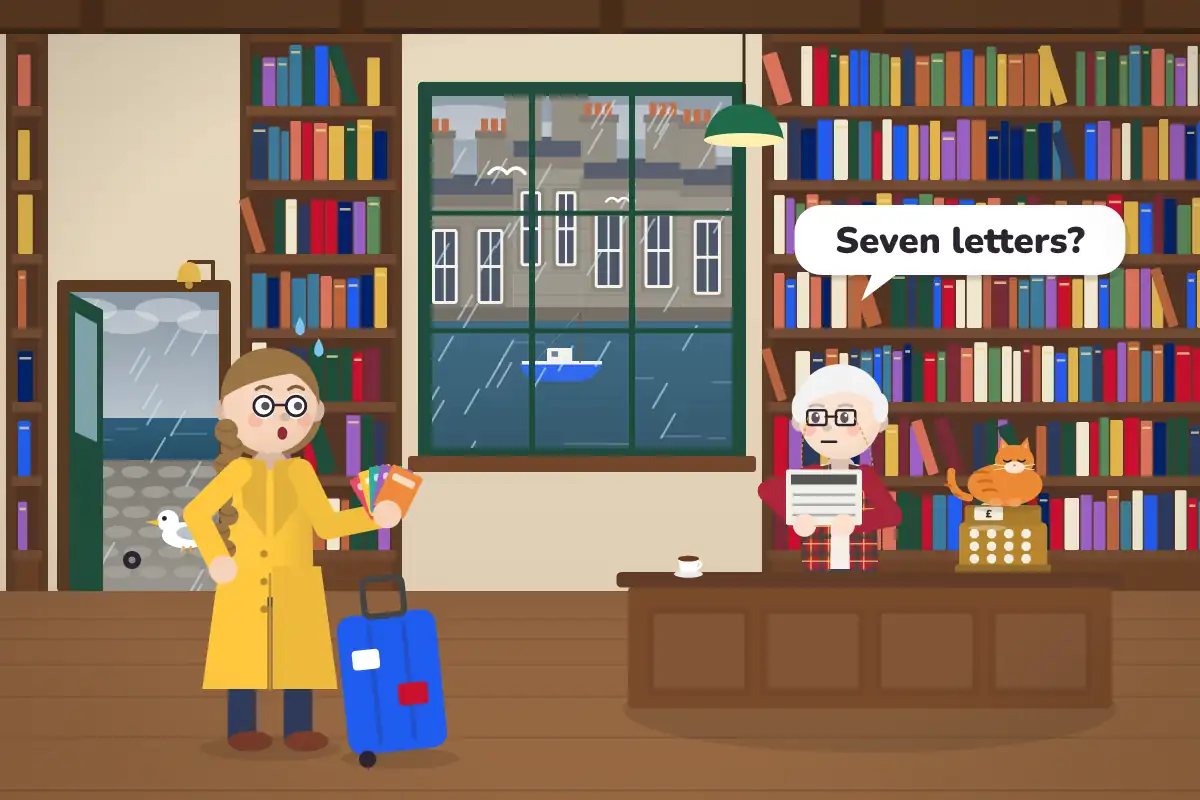
The bookshop is dark green, with gold letters: The Second Chapter. In the window, there are piles of old books. Zosia opens the door, and a little bell rings. Inside, there are books everywhere: on shelves, on chairs, on the floor. An old lady is sitting behind the counter. She has got short white hair and glasses on a chain. She’s doing the crossword in the newspaper. She doesn’t look up. On the till, a fat ginger cat is sleeping.
Zosia opens her mouth. The perfect sentence isn’t there. ‘Seven letters,’ says the lady. ‘A person who worries too much.’ Zosia thinks for a second. ‘…Worrier?’ ‘That’s seven. Good. You’re hired. Again.’ ‘I’m Morag Baird. The cat is Dickens. He’s in charge of poetry.’ ‘Are you a teacher or a student?’ ‘Actually, I’m a student,’ says Zosia. ‘Actually? You don’t sound very sure, dear.’
Above the shop, there’s a small room with a window. ‘It’s yours,’ says Morag. ‘Until you find a flat.’
🌍 Ciekawostka: Edynburg w sierpniu, Leith i krzyżówki
Edinburgh Festival Fringe to jeden z największych festiwali sztuki na świecie: w sierpniu w mieście odbywają się tysiące przedstawień — teatr, komedia, muzyka, cyrk. Na Royal Mile (ciąg ulic od zamku do pałacu Holyrood) występują artyści uliczni, a każdy przechodzień dostaje flyers — ulotki. Czternaście w dziesięć minut to w sierpniu wynik zupełnie normalny. W tym samym miesiącu trwa też międzynarodowy festiwal książki.
Leith było kiedyś osobnym miastem portowym, dziś to dzielnica Edynburga. Ulica The Shore biegnie nad rzeką Water of Leith, a tramwaj jedzie z lotniska przez centrum aż do Leith i Newhaven. Szkoci sami żartują, że ich pogoda to four seasons in one day — cztery pory roku w jeden dzień. Stąd rada Morag: Bring an umbrella.
A krzyżówki? Brytyjskie gazety drukują je codziennie, a najbardziej wymagające są cryptic crosswords — każde hasło to mała zagadka słowna. Liczba w nawiasie podaje liczbę liter, np. (7). Morag rozwiązuje je codziennie. Przy pracy. Zamiast pracy.
🙈 Wpadka Zosi: actually to NIE „aktualnie”!
Zosia chce powiedzieć „aktualnie jestem studentką” i mówi Actually, I’m a student. Dla Morag brzmi to jak „właściwie… to jestem studentką” — jakby Zosia się poprawiała albo sama nie była pewna. Stąd ironiczne You don’t sound very sure, dear.
| Po angielsku | Znaczy | A „aktualnie / aktualny” to… |
|---|---|---|
| actually | właściwie, tak naprawdę, w gruncie rzeczy | at the moment, currently, now |
| actual | rzeczywisty, faktyczny | current, up to date |
| Actually, I’m from Gdańsk. | Tak naprawdę jestem z Gdańska (a nie np. z Warszawy). | At the moment, I live in Leith. |
Poprawnie: At the moment, I’m a student. albo I’m currently a student. Actually zostaw na sytuacje, gdy prostujesz czyjeś przypuszczenie: Actually, the cat is the boss.
A Stamp in an Old Book
Ostatnia czytanka dzieje się wieczorem, w pokoju nad sklepem. Jeśli poprzednie czytałeś z tłumaczeniem, spróbuj tę najpierw tylko słuchać — włącz „Czytaj rozdział” i idź za lektorem wzrokiem.
A Stamp in an Old Book
Czytanka 3 · 26 zdańZosia’s room is small, but it’s lovely. There’s a bed, a desk, a kettle and a lot of books. There isn’t a TV, but there’s a window with a view of The Shore. At nine o’clock, her phone rings. It’s Mum, on video. Mum has got a lot of questions, all in Polish. Is Zosia eating hot meals? Is the room cold? Is the boss nice? ‘The boss is… interesting,’ says Zosia. ‘And the cat is the manager.’ Mum is quiet for a moment. Then she asks about warm socks.
After the call, Zosia opens her backpack. Inside, there’s an old book: ‘Poems’ by Robert Burns. It’s from pan Janek, an old neighbour from Gdańsk. In Zosia’s memory, pan Janek is always old, quiet and kind. He teaches English to all the children in their block of flats. For free. ‘Edinburgh is the most beautiful city in the world,’ he says. Pan Janek is gone now. But his books aren’t. A big box of them is in her parents’ basement in Gdańsk.
Zosia opens the book. On the first page, there’s an old stamp. She knows this stamp from childhood. For little Zosia, ‘The Shore’ is a place in a fairy tale. Tonight, she reads it again, very slowly: ‘MacKay’s Books. The Shore. Leith.’ Zosia looks at the stamp. Then she looks at the window. She opens the window. It’s dark, and the river is black. Next to the window, an old wooden sign is swinging in the wind. The letters are faded, but she can read them: MacKay’s Books. Zosia sits on the bed with the book in her hands. She lies awake for a long time.
Pokój nad księgarnią
👆 Kliknij przedmiot — usłyszysz jego nazwę. Ten pokój będzie domem Zosi przez całą jesień.
🗂️ Ważne słowa z czytanek 2 i 3
Port, księgarnia i pokój nad sklepem — te słowa wrócą w każdym rozdziale.
🧩 Jak to działa: Present Simple — co ktoś robi zwykle, zawsze, w ogóle
Present Simple to czas faktów i przyzwyczajeń: kim jesteś, co lubisz, co robisz codziennie. Jest bardzo prosty — tylko on, ona, ono dostają końcówkę -s. Przeczenie i pytanie robisz słówkiem pomocniczym do / does, a wtedy -s znika z czasownika.
| Kto? | Twierdzenie | Przeczenie | Pytanie |
|---|---|---|---|
| I, you, we, they | I know | I don’t know | Do you know? |
| he, she, it | she knows | she doesn’t know | Does she know? |
She doesn’t look up.
Does pan Janek teach English? Yes, he does.
Pisownia z -es: po -s, -sh, -ch, -x, -o — watches, goes, teaches. Spółgłoska + y zmienia się w -ies: worry → she worries. I jeden wyjątek: have → she has.
🗣️ Jak to wymówić: th — dźwięk, którego nie ma w polskim
Polak zamienia th na „f”, „t”, „s” albo „d” — i Brytyjczyk od razu słyszy akcent. Sposób jest jeden: czubek języka między zęby, lekko, bez gryzienia.
- three [θriː], think [θɪŋk], thank you [ˈθæŋk juː] — [θ] bezdźwięczne: język między zębami i dmuchnij jak przy „s”.
- the [ðə], this [ðɪs], there [ðeə], mother [ˈmʌðə] — [ð] dźwięczne: to samo ułożenie, ale z głosem, jak przy „z”.
There’s the castle, and that’s the tram.
Ćwicz przed lustrem: jeśli widzisz czubek języka — robisz to dobrze. Wygląda trochę głupio. Wszyscy Brytyjczycy tak wyglądają.
🛟 Zwroty ratunkowe — naucz się ich na pamięć
Sześć zdań, które ratują każdą rozmowę, gdy angielski leci za szybko — i lepszych niż I am fine, thank you, and you? Kliknij, posłuchaj, powtórz na głos.
- Excuse me, can you help me?Przepraszam, może mi pan/pani pomóc?
- Sorry, could you say that again?Przepraszam, może pan/pani powtórzyć?
- Could you speak more slowly, please?Czy może pan/pani mówić wolniej?
- Sorry, I don’t understand.Przepraszam, nie rozumiem.
- Where’s the tram stop, please?Gdzie jest przystanek tramwajowy?
- Cheers! Thanks a lot.Dzięki! Bardzo dziękuję. (Cheers — codzienne brytyjskie „dzięki”)
Sprawdź, czy zrozumiałeś
🎯 Sześć pytań do rozdziału
✅ Co już potrafisz po tym rozdziale
- zapytać o drogę i poprosić o powtórzenie — zamiast recytować podręcznik,
- napisać krótki, uprzejmy e-mail w sprawie pracy (Dear Sir or Madam … Yours faithfully),
- używać am / is / are i mówić, co gdzie jest: there is / there are,
- opowiadać w Present Simple — z -s przy he / she / it,
- nie mówić actually, gdy chodzi ci o „aktualnie”,
- wymówić th z językiem między zębami — i nazwać to, co widzisz na The Shore i w swoim pokoju.
Wróć tu jutro i przeczytaj czytanki jeszcze raz bez tłumaczenia. Drugie czytanie jest tym, po którym słownictwo zostaje w głowie.